Iceland Defense Force
Operation NapoleonThe Iceland Defense Force is the military presence associated with the North Atlantic Treaty Organization base at Keflavík Airport, where strategic defense meets Iceland’s insistence on sovereignty and distance from foreign military power. In the novel, that presence is neither simply imposed nor simply welcomed: it is a source of political friction, local dependence, and concealed activity. The force’s history helps explain why a military operation on Icelandic territory can be defended as necessary while remaining politically explosive.
Base and Historical Setting
The base stands on Midnesheidi moor at the western tip of the Reykjanes Peninsula, amid exposed lava fields and severe winds. Its runway, hangars, barracks, shops, cinema, and administrative buildings make it a substantial military settlement in an otherwise bleak landscape. The naval air station had served as a center for reconnaissance flights during the Cold War era in Iceland, although its activities had been greatly curtailed by the time of the novel’s 2000 events.
The military presence grew out of wartime defense arrangements. Britain occupied Iceland at the beginning of the Second World War and transferred the defense role to the United States in 1941. The American headquarters was initially in Reykjavík; the force was later reinforced by the 5th Infantry Division, and the occupying American force eventually peaked at about 38,000 troops. This wartime scale belongs to the wider history of American occupation rather than establishing the Iceland Defense Force’s own size, but it underscores how deeply foreign military power had entered Icelandic life.
Treaty, Sovereignty, and Political Opposition
The defense treaty signed in 1949 made the military presence a continuing domestic controversy. Its ratification triggered a riot outside the Icelandic parliament, and left-wing parties remained strongly opposed to the base. The dispute was not merely about military policy: it concerned who could exercise authority on Icelandic soil and whether the country could protect its independence while relying on a foreign defense presence.
The novel also sets official policy against the practical arrangements that sustained the base. Iceland’s government had decreed that the nation should derive no profit from the North Atlantic Treaty Organization presence, and the military did not pay directly for its Keflavík Airport facilities. Yet civilian contractors and service companies doing work for the military received tens of millions of dollars, while neighboring villages came to depend on the Iceland Defense Force’s presence. When operations on Midnesheidi were scaled down after the Cold War, local protests followed. The contrast exposes the limits of a policy of non-benefit: public money might not flow directly to the state, but military activity still shaped livelihoods and local economies.
Work at the Base and on the Glacier
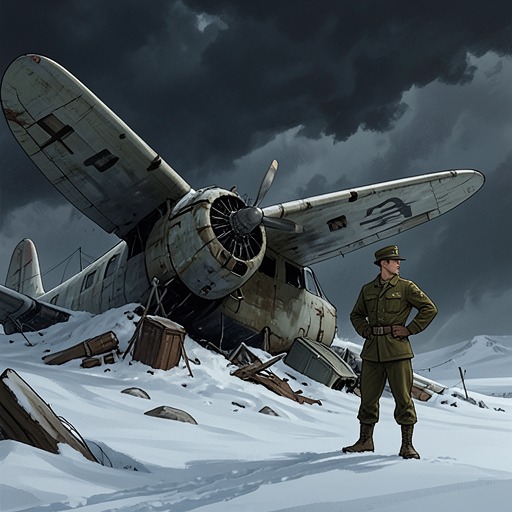
The force’s operational history reaches beyond the base. In the American general’s account to Icelandic ministers, a U.S. aircraft had crashed on Vatnajökull in the closing stages of the Second World War. Bad weather prevented an early search, and when a search party from the Defense Force in Reykjavík eventually reached the glacier, the plane had disappeared beneath the ice. The account makes the glacier’s burial of the aircraft part of the institution’s history, and the lost wreck later becomes the reason for renewed surveillance and military interest.
In 2000, American military personnel arrived at Keflavík Airport aboard a C-17 with snowmobiles, tracked vehicles, and equipment for work on the glacier. Delta Force operators were among those involved. This was a covert U.S. operation, not evidence that the Iceland Defense Force itself directed the recovery: the distinction matters as Icelandic officials challenged the Americans over what was happening on their territory. In a meeting with the Icelandic government, the American general described the defense treaty as authority for monitoring Iceland and its surroundings for military purposes, including surveillance of Vatnajökull. The general also disclosed a German bomb on the glacier to press the ministers to recall their rescue team, making an asserted danger the basis for an urgent demand.
People, Dependency, and Public Meaning
The base is shown through the lives of personnel as well as through treaties and operations. Steve, stationed there for three years, works in the press office liaising with Icelandic ministries, chiefly the foreign ministry. His position places him between the American military and Icelandic civilian government. Michael Thompson, recalling his posting to Iceland after service in Korea, describes the isolation of the base and the locals’ hostility, but also points to Iceland’s reliance on military spending. His account is a serviceman’s perspective, not a neutral statement of Icelandic policy; its value lies in bringing the contradiction into personal view.
That contradiction gives the Iceland Defense Force its narrative significance. Icelanders may protest the base and discourage contact with its personnel, while communities nearby have reason to fear its decline. At the same time, the secret glacier operation reveals how an arrangement publicly justified through defense can conceal actions that the Icelandic government has not been fully told about. The organization therefore stands at the intersection of security, economic dependence, and disputed sovereignty: present enough to shape daily and national life, yet politically difficult to acknowledge without qualification.